

Stripes, again
The image on the screen was a series of vertical stripes — alternating color and white, clean and repeating, applied directly to a wall. I didn't know the name yet. I just recognized the stripes.
The work was by Daniel Buren. I spent an hour going through his pieces. The colored series, the black and white, the installations that transform buildings and public spaces into something you see differently — as if the stripes recalibrate your sense of proportion and distance. What drew me immediately was how they don't decorate a space. They structure it. They create form where there was only architecture.
I wrote about stripes last August. About Michel Pastoureau and the history of striped cloth, about how stripes arrived in my studio almost by accident and then wouldn't leave. I thought I had found the edges of the obsession. Then Buren.
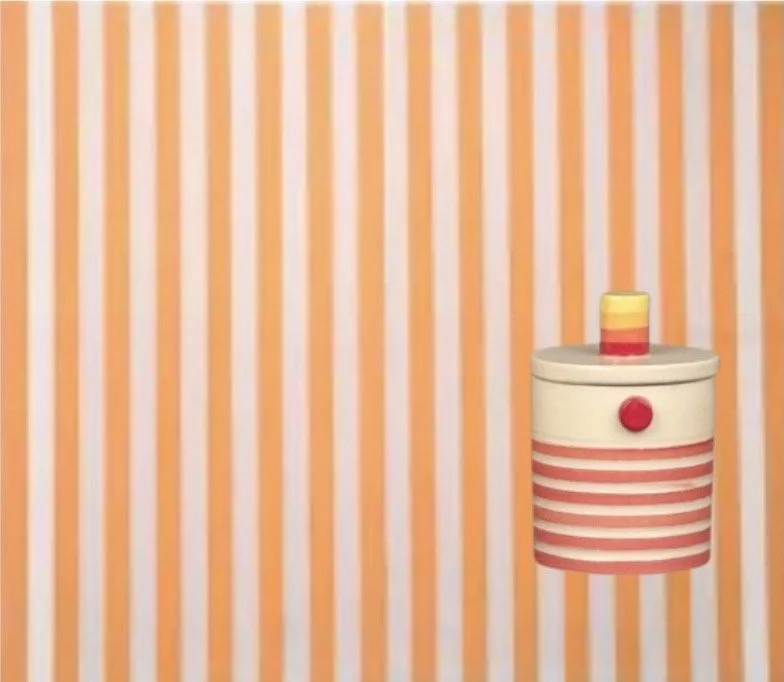
His stripe is famous for being exact: 8.7 centimeters wide, always alternating with white, applied as a rule rather than a choice. The hand is deliberately absent. Buren's stripe is not made — it is deployed. It questions the institution, the frame, the authority of the art space itself. It's a conceptual gesture masquerading as a surface pattern.
Mine come from a body. From a tool held still while the clay spins. The line emerges from momentum, from the relationship between stillness and rotation. Each one is slightly different. They carry the history of that particular throwing session — the speed of the wheel, the pressure of my hand, how tired I was, how careful.
And yet I don't experience this as contradiction. Looking at his work, I feel something clarify in my own. His rigidity throws my variability into relief. His institutional scale makes me appreciate the intimacy of a cup, a ring, a small stand for a single cupcake. Where his stripes expand into architecture, mine contract into something held in a hand.
There is also something I genuinely admire in his commitment to the rule. A constraint that liberating — choosing one width, one alternation, forever — must produce its own kind of freedom. The stripe becomes invisible as decision, and what remains is pure effect: space transformed, perception shifted.
I am not there. My stripes still carry my uncertainty, my experiments, the small mistakes I've come to like. But understanding Buren's opposite logic has given me a clearer sense of what my own approach actually is. Not rule, but rhythm. Not system, but repetition with variation. The stripe as a living gesture rather than a deployed one.
I don't know yet what this means for the work ahead. But the dialogue is open.
Buren has maintained the exact measurement of 8.7 cm across his work since 1966. For documentation, see the Centre Pompidou collection entry or his studio statement at danielburen.com.